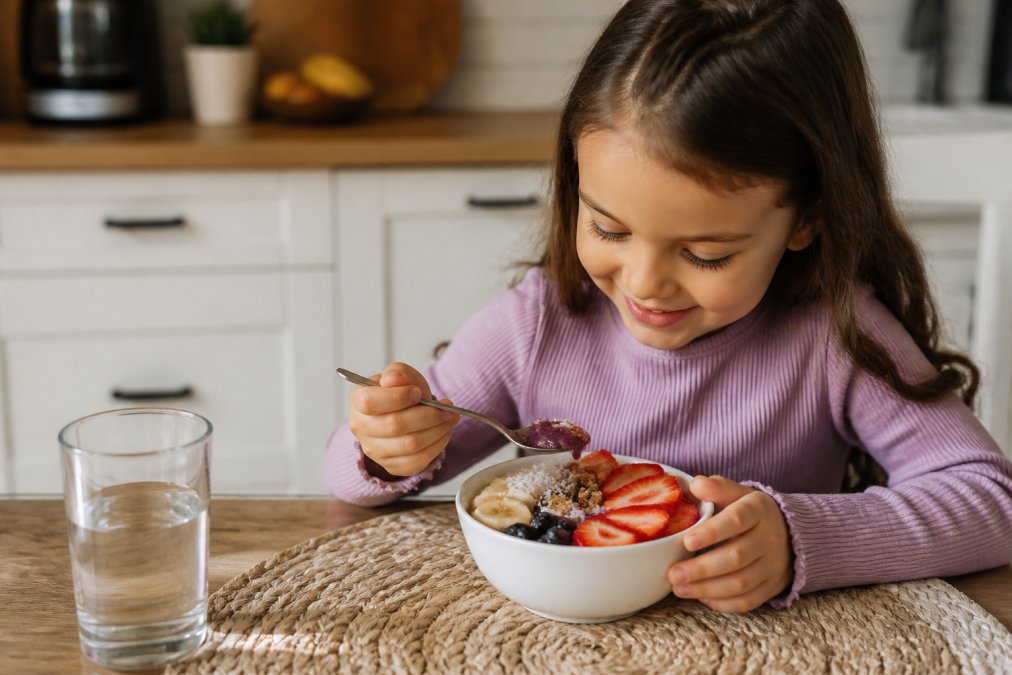
 ultimate-guide
Is Acai Bowl Good for Kids? A Parent's 2026 Guide
Table of Contents
- Is Acai Bowl Good for Kids? The Short Answer
- Acai Bowl Sugar Content: What Parents Need to Know
- Healthy Smoothie Bowl Toppings for Kids
- How to Make a Kid-Friendly Acai Bowl at Home
- Potential Risks: Allergies, Caffeine, and Infant Botulism
- Acai Bowls vs. Other Fruit Smoothies for Kids
- Conclusion: Making Acai Bowls a Smart Choice
- Frequently Asked Questions
Last Updated: September 18, 2026
Is Acai Bowl Good for Kids? The Short Answer
Yes, an acai bowl can be a genuinely good choice for kids, provided you manage portion size, sugar, and toppings. At Roxberry Juice Co., we blend ours to order from real fruit. The catch is that "healthy" depends far less on the acai itself and far more on what gets piled on top.
What Makes Acai a Superfood for Growing Bodies
Acai earns its superfood label from antioxidants, fiber, and healthy fats, three things kids' diets often run short on. It also supplies small amounts of amino acids and omega fatty acids for developmental nutrition. That said, acai is not magic, think of it as one colorful piece of a whole foods plate, not the whole plate.
- Antioxidants help the body manage everyday oxidative stress
- Fiber supports digestion and helps prevent childhood constipation
- Healthy fats and omega fatty acids support brain and eye development
- Vitamin C contributes to immune support
Age-by-Age Serving Guidelines
Serving size matters more than most parents expect. A bowl that fills an adult is often two or three times what a small child needs.
| Age | Serving Size | Texture | Watch For |
|---|---|---|---|
| Under 12 months | Not recommended | N/A | Honey, choking hazards |
| 1-3 years | 2-4 oz | Thin, smooth | Choking risk from whole nuts |
| 4-8 years | 4-6 oz | Soft, spoonable | Added sugar creep |
| 9-13 years | 6-8 oz | Standard bowl | Topping overload |
- Under 12 months: Skip acai bowls entirely, the honey in many recipes poses an infant botulism risk, and cold, dense purees aren't ideal first foods.
- Toddlers: Keep portions small and textures thin; cut fruit into pea-sized pieces and skip whole nuts.
- Older kids: A standard bowl is fine, but watch the toppings, that's where sugar and calories multiply.
Acai Bowl Sugar Content: What Parents Need to Know
Sugar is the single biggest reason a "healthy" acai bowl stops being healthy. The acai berry itself is low in sugar, the trouble arrives through the base puree, sweetened yogurt, juice, and toppings. Parents often assume the fruit is the problem, but the added sugars in the base and toppings do most of the damage.
How Much Added Sugar Is Too Much for a Child
The Dietary Guidelines for Americans recommended limits on added sugars advise keeping added sugars under 10% of daily calories. For most young children eating around 1,200-1,600 calories a day, that works out to roughly 30-40 grams of added sugar for the entire day, not per snack. The American Heart Association guidance on added sugars for children takes a stricter view and recommends children and teens stay under about 25 grams of added sugar daily, and under 6 teaspoons (about 25 grams) for kids age 2 and older.
Reading a Frozen Acai Packet Label
Frozen acai is sold in two forms, and they are not interchangeable:
- Unsweetened puree packets, ingredients list reads "organic acai" or "acai pulp" and little else. Sugar comes only from the fruit.
- Sweetened smoothie packets, the ingredient list often includes cane sugar, evaporated cane juice, guarana syrup, or added fruit juice concentrates. These are the packets behind most "why is my bowl so sweet?" surprises.
Natural vs. Added Sugars in Acai Bowls
Natural sugars occur in the fruit itself, packaged with fiber, water, and micronutrients. Added sugars are sweeteners put in during preparation: honey, agave, cane sugar, maple syrup, sweetened yogurt, and juice concentrates. Fiber slows sugar absorption, while added sweeteners spike energy levels and then crash them. Simple rule: if the bowl tastes like dessert, it probably is one.
How to Spot Hidden Sugars in Toppings
Toppings are the silent sugar carriers. Granola, dried fruit, chocolate chips, flavored yogurt, and sweetened coconut all add sugar that parents rarely count.
- Granola: often sweetened with honey or syrup; check the label or ask
- Dried fruit: concentrated sugar, a small handful of dried cranberries or raisins can carry as much sugar as a full cup of fresh berries
- Flavored yogurt: can contain more sugar than plain varieties; compare the Added Sugars line against plain Greek yogurt, which typically lists 0 g
- Juice concentrates: used as "natural" sweeteners, still added sugar
- Chocolate chips and candy: treat these as dessert, not a topping
- Honey and agave drizzles: one tablespoon of honey is about 17 grams of sugar, roughly half a young child's daily added-sugar allowance
A Sugar-Smart Build Order
To keep a bowl genuinely kid-friendly, build it in this order:
- Start with unsweetened acai puree as the base.
- Add frozen banana for natural sweetness and creaminess, no added sugar required.
- Skip the honey and juice drizzle entirely for kids under 2, and use it sparingly after that.
- Choose two fresh-fruit toppings before any granola or dried fruit.
- Portion granola last, by the tablespoon, and treat it as a garnish rather than a layer.
Healthy Smoothie Bowl Toppings for Kids
The best healthy smoothie bowl toppings for kids add nutrition and texture without a sugar spike:
- Fresh berries: strawberries, blueberries, raspberries for antioxidants and vibrant colors
- Banana slices: potassium and natural sweetness
- Plain Greek yogurt: protein and healthy fats without added sugar
- Chia or flax seeds: omega fatty acids and fiber for digestion
- Unsweetened coconut: texture and healthy fats
- A light sprinkle of granola: for crunch, portioned deliberately
Nut-Free and Allergy-Friendly Options
Nut allergies are common in young children, so a nut-free build is often the safer default. Swap peanut butter and almond butter for sunflower seed butter, and skip granola blends that may contain tree nuts. Some children with existing fruit or pollen allergies can react to acai or its common companions, so introduce new toppings one at a time.
How to Make a Kid-Friendly Acai Bowl at Home
Making a kid-friendly acai bowl at home takes about 10 minutes and gives you full control over sugar, texture, and toppings.
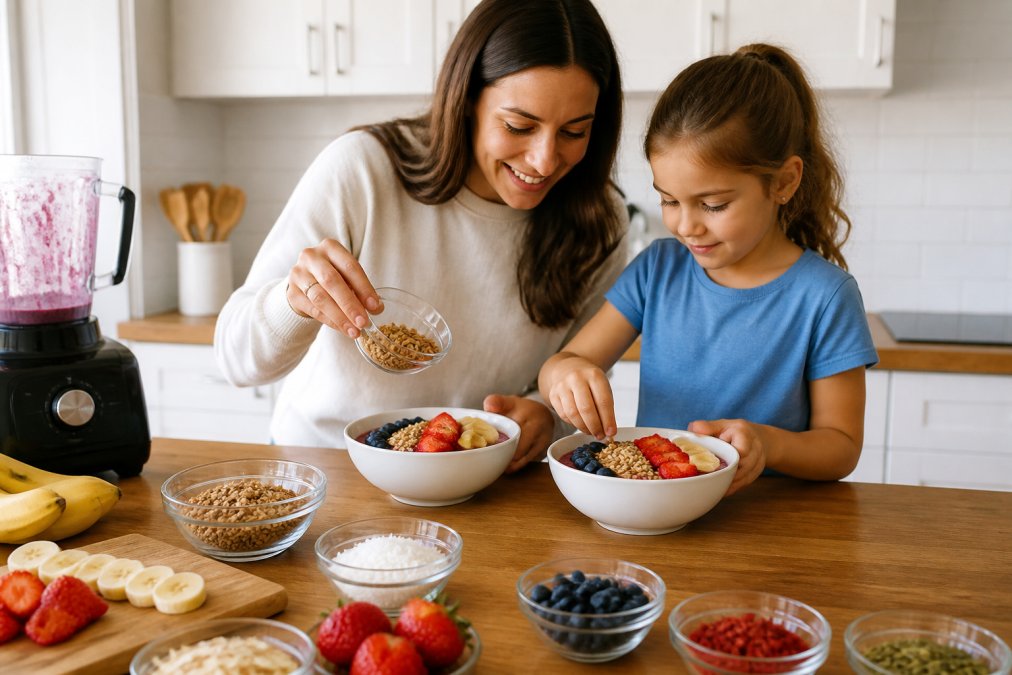
What you'll need:
- Frozen acai puree packets (unsweetened if you can find them)
- Frozen banana for creaminess
- A splash of milk or a plant-based alternative
- Toppings of choice
Steps:
- Soften the puree. Run the frozen packet under warm water for 20-30 seconds so it breaks apart in the blender.
- Add liquid sparingly. Start with a small splash. Too much liquid turns a bowl into a drink.
- Blend the base. Combine acai, frozen banana, and liquid until smooth and thick.
- Check the texture. It should hold a spoon upright. Add fruit, not liquid, to thicken.
- Pour and top. Transfer to a bowl and add toppings in small portions.
- Serve immediately. Acai melts fast, and a melted bowl becomes a smoothie.
Blending Tips for the Right Texture
Texture is make-or-break for kids: too icy gets rejected, too thin feels like baby food. For younger kids, blend longer for a smoother result.
Potential Risks: Allergies, Caffeine, and Infant Botulism
Acai bowls carry a few real risks parents should know about, not reasons to panic, but reasons to pay attention.
Caffeine: Small Bodies, Small Margins
Caffeine content is the most overlooked risk. The acai berry itself contains negligible caffeine, but many shop bowls and packaged bases include guarana, green tea, matcha, or yerba mate, all added for energy and all carrying real caffeine. Guarana is the one to watch most closely: it is an Amazonian seed used in many "energy" acai blends, and its caffeine is concentrated enough to deliver a meaningful dose in a single bowl.
Allergies and Cross-Reactivity
Allergies are the second concern. Reactions to acai itself are uncommon; the more likely triggers travel with it. Cross-reactivity happens when a child's immune system, already sensitized to one protein, reacts to a similar protein in an unrelated food. Common pairings in acai bowls:
- Tree nuts and peanuts, the most frequent triggers in bowls, via nut butters, granola blends, and almond milk
- Seeds, sunflower, chia, and flax are less common triggers but still possible, and sunflower seed butter is a frequent nut-butter substitute
- Birch pollen-related fruits, some children with birch pollen allergy react to raw apple, cherry, or peach, all common bowl toppings
- Latex-related fruits, banana, kiwi, and avocado can cross-react in children with latex sensitivity
- Honey, not an allergy, but a botulism risk for infants, covered below
Infant Botulism: The Hard Stop Under One Year
Infant botulism applies only to babies under 12 months, and it is the one risk with no gray area. Honey, a common acai bowl sweetener and frequent granola ingredient, can carry Clostridium botulinum spores, and an infant's digestive tract is not developed enough to keep them from germinating. Honey is off the table entirely for the first year.
Choking Hazards by Age
A fourth risk gets less attention than it deserves: choking. Whole nuts, large seeds, big chunks of frozen fruit, and thick spoonfuls of nut butter are hazards for young children.
- Under 4: cut fruit into pea-sized pieces, skip whole nuts and large seeds, and thin nut butters with water or yogurt
- Ages 4-8: cut grapes and large berries lengthwise, and supervise while eating
- Any age: have kids sit down to eat, eating while walking or playing raises choking risk
For kids over one, the main risks in an acai bowl are caffeine from energy-boosting add-ins and sugar from toppings. For babies under one, honey is the hard stop. For toddlers, choking hazards from nuts and large fruit pieces are the everyday concern. Everything else comes down to portion and ingredient choices, and to asking what's actually in the base before you order. ::: Balancing these nutritional variables often leads parents to explore clean toddler supplements as a way to fill potential gaps in a developing diet.
Acai Bowls vs. Other Fruit Smoothies for Kids
An acai bowl and a fruit smoothie are close cousins, but the differences matter for kids. The bowl is thicker and eaten with a spoon, which slows eating and feels more like a meal. A smoothie is drunk, often faster, and easier to overload with juice and sweetener. Nutritionally the two can be nearly identical, what separates them is control.
| Factor | Acai Bowl | Fruit Smoothie |
|---|---|---|
| Texture | Thick, spoonable | Drinkable |
| Eating pace | Slower | Faster |
| Topping control | Visible, portioned | Hidden |
| Sugar risk | Toppings and base | Juice and sweeteners |
| Best for | Sit-down snack | On-the-go |
Conclusion: Making Acai Bowls a Smart Choice
An acai bowl can be a smart, nourishing choice for kids when you control the sugar, watch the caffeine, and keep portions age-appropriate. The berry brings antioxidants, fiber, and healthy fats. The risk lives in the toppings and the base, not the fruit.
Frequently Asked Questions
Is acai berry safe for children to eat?
Yes, acai berries are generally safe for children over 12 months old. The fruit is rich in antioxidants, fiber, and healthy fats. However, always introduce acai in small amounts first to check for allergic reactions. Avoid honey as a topping for babies under 12 months due to infant botulism risk. For young children, choose unsweetened acai puree and keep servings small, around 2 to 4 ounces.
Is acai too high in sugar?
Plain acai puree contains about 2 to 4 grams of sugar per 100 grams, which is low. The sugar content in an acai bowl comes mostly from added toppings like granola, honey, and fruit juices. A typical cafe acai bowl can have 20 to 40 grams of sugar. To reduce sugar, use unsweetened acai, limit high-sugar toppings, and sweeten with banana or a small amount of maple syrup instead of honey or cane sugar.
At what age can a child start eating acai bowls?
Most pediatricians suggest waiting until a child is at least 12 months old before introducing acai bowls. For toddlers, serve a small portion of plain, unsweetened acai blended smooth to avoid choking hazards. Avoid toppings like whole nuts, large seeds, or honey for children under 2. Always supervise young children while they eat and adjust texture based on their chewing skills.
How can I reduce the sugar content in my child's acai bowl?
Start with unsweetened acai puree instead of sweetened packets. Use naturally sweet fruits like bananas, berries, or mango to add flavor without extra sugar. Skip honey, agave, and fruit juice concentrates. For toppings, choose unsweetened coconut flakes, chia seeds, or a small spoon of nut butter. Check granola labels for added sugar, as many brands pack 8 to 12 grams per serving. A homemade bowl can have under 15 grams of sugar total.