 how-to
Customize Restaurant Meals for Dietary Restrictions
Table of Contents
- Understand Your Dietary Needs Before You Order
- How to Communicate Food Allergies to a Restaurant
- Questions to Ask Restaurants About Food Allergies
- How to Avoid Cross-Contact When Dining Out
- Restaurant Meal Substitutions for Dietary Restrictions
- Customize Restaurant Meals with Confidence
- Frequently Asked Questions
Last Updated: October 12, 2026
Understand Your Dietary Needs Before You Order
Before you walk into a restaurant, get clear on what you actually need to customize restaurant meals dietary restrictions. A preference is something you'd like to avoid; a restriction is something that makes you sick or poses a real health risk.
Start by writing down your specific dietary needs:
- Medical restrictions (allergies, intolerances, conditions)
- Religious or ethical requirements
- Personal preferences
- Ingredients you absolutely cannot have
- Cross-contact concerns (if relevant)
When you customize restaurant meals for dietary restrictions, clarity prevents mistakes. Many restaurants want to help, they just need to know exactly what you need.
At Roxberry Juice Co., we work with guests daily who have specific dietary needs. We keep detailed ingredient lists available and train our team to answer questions about every smoothie, juice, and bowl.
How to Communicate Food Allergies to a Restaurant
Start the conversation before you order. Alert your server or the person taking your order immediately, don't wait until your food arrives.
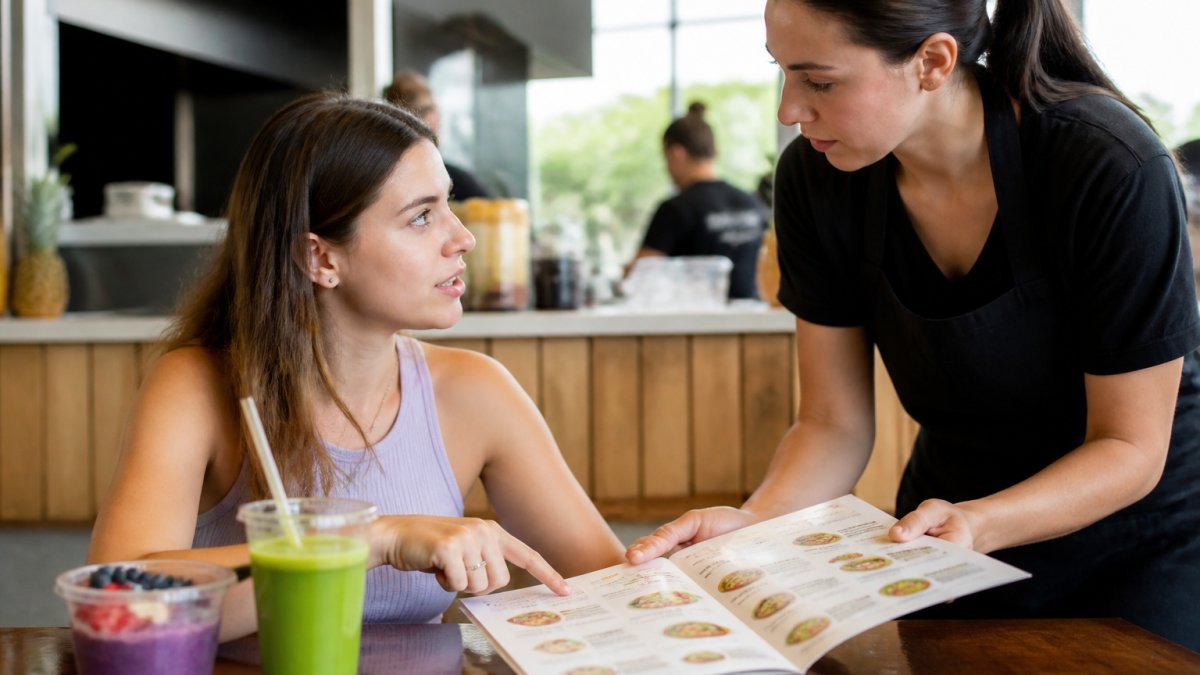
Use clear, direct language. Say "I have a peanut allergy," not "I'm allergic to peanuts, kind of." The word "allergy" signals severity and gets attention.
Repeat your allergy to multiple staff members if possible. Tell the server, ask them to tell the kitchen, and confirm the message was received.
Use these exact words when ordering:
"I have a [specific allergy]. I cannot have [ingredient]. Please make sure the kitchen knows about this allergy."
Then wait for confirmation. A good restaurant repeats your allergy back and explains how they'll handle your order. If they seem unsure or dismissive, order something simpler or go elsewhere.
Questions to Ask Restaurants About Food Allergies
Essential questions for allergy safety
Ask these questions before you order:
- "How do you prevent cross-contact with [allergen]?"
- "Can you tell me every ingredient in this dish?"
- "Is this dish prepared in a separate area of the kitchen?"
- "Do you use the same utensils or cutting boards for different dishes?"
- "Has this dish ever contained [allergen], even if it doesn't now?"
A restaurant that answers clearly is safer than one that hesitates or seems annoyed.
Questions about ingredient sourcing and preparation
Ask about where ingredients come from and how they're handled:
- "Do you know where your [specific ingredient] is sourced?"
- "Are any of your ingredients processed in a facility that also processes [allergen]?"
- "How long has this item been on your menu?"
- "Who prepares this dish, and do they know about my allergy?"
Either answer is useful, it tells you what they can guarantee and what they can't. When you customize restaurant meals for dietary restrictions, these conversations aren't rude; they're necessary.
How to Avoid Cross-Contact When Dining Out
Cross-contact happens when an allergen touches food that shouldn't contain it, a knife used on peanut butter, then on your bread; a cutting board that touched shellfish, then your salad. These small transfers can trigger allergic reactions.
Ask your restaurant how they prevent this. Listen for:
- Separate utensils and cutting boards for allergen-free meals
- Hand washing between tasks
- Separate prep areas or timing
- Staff training on cross-contact risks
If cross-contact is dangerous for you, you need a restaurant that can promise separation. Don't settle for "probably fine."
For severe allergies, simple meals are safer: a grilled chicken breast with plain vegetables and a baked potato has fewer chances for cross-contact than a complex sauce-based dish.
Restaurant Meal Substitutions for Dietary Restrictions
Know what a kitchen can realistically change, what it usually cannot, and the exact words that get you a safe result. Below are concrete substitutions by dish type, plus a reusable ordering script.
The ordering script that works
Use this sequence every time, in this order:
- State the restriction and severity. "I have a severe dairy allergy, it's medical, not a preference."
- Name the dish you want and the change. "I'd like the grilled salmon, but can it be cooked in oil instead of butter?"
- Ask the cross-contact question. "Does that salmon touch the same pan or utensils as anything with butter or cream?"
- Ask for confirmation back. "Can you repeat back what the kitchen will do?"
- Confirm at delivery. "This is the salmon cooked in oil with no butter or cream, correct?"
That last step matters. A server can take the order correctly and the kitchen can still plate the wrong version. Confirming at delivery catches the error before you eat.
Substitutions by dish type
Burgers and sandwiches. The patty is usually safest; the bun and sauces are the risk.
Pasta. Ask whether the kitchen stocks gluten-free pasta or can serve the sauce over rice, polenta, or vegetables.
Mexican and Tex-Mex. Corn tortillas are typically gluten-free; flour tortillas are not.
Pizza. Ask whether the kitchen uses a separate gluten-free crust, cutter, and pan. A shared pizza cutter drags gluten across a gluten-free crust.
Dessert. Fruit, sorbet, and plain ice cream are the common safe options.
Gluten-free and gluten-friendly swaps
- Bread: lettuce wraps, rice, potatoes, or corn tortillas instead of wheat bread
- Pasta: gluten-free pasta, rice, or vegetables instead of wheat pasta
- Breading: grilled or baked proteins instead of fried
- Sauces: ask whether the sauce uses flour or a gluten-based thickener; pan drippings and gravies often do
Focus on naturally gluten-free foods: vegetables, rice, potatoes, and plain proteins. Avoid fried foods unless the restaurant uses a dedicated fryer, shared oil is a common cross-contact point.
Vegetarian and plant-based alternatives
- Order a vegetable-heavy appetizer as your main course
- Ask for a protein substitution: beans instead of chicken, tofu instead of fish
- Request double vegetables or sides in place of meat
- Build a meal from side dishes: rice, beans, roasted vegetables, salad
Ask whether the beans are cooked with meat or the rice with chicken broth, the two most common hidden animal ingredients in otherwise vegetarian-looking dishes.
Dairy-free and allergen-friendly options
Dairy hides in butter on vegetables, cream in soups, and cheese in "vegetarian" dishes. Ask:
- "Is this cooked in butter or oil?"
- "Does this sauce contain cream or cheese?"
- "Can you prepare this without dairy?"
Common swaps: oil instead of butter, broth-based soups instead of cream soups, vegetables and proteins without sauce, fruit instead of dessert. Most kitchens keep olive oil on hand and can cook dairy-free if you ask clearly.
When a substitution isn't worth it
If the kitchen has to rebuild a dish from the ground up, swapping the base, sauce, and garnish, the risk of error goes up. Pick a dish naturally close to your needs rather than one requiring four changes.
Customize Restaurant Meals with Confidence
Confidence comes from a clear decision framework, not from hoping the kitchen gets it right. Use the steps below to decide whether to order, modify, or walk away.
The cross-contact checklist
Before you commit to a dish, run through these questions:
- Shared fryers: "Is the fryer used only for gluten-free or allergen-free items, or is it shared?" Shared fryers are one of the most common cross-contact sources (Avoiding Cross-Contact).
- Utensils and cutting boards: "Will this be prepared with utensils and a cutting board that haven't touched [allergen]?"
- Prep surfaces: "Is there a separate prep area, or is the same counter used for everything?"
- Hands and gloves: "Will the person preparing this change gloves first?"
- Cooking surfaces: "Is the grill, pan, or wok wiped down or separate?"
- Plating: "Will the plate be handled separately from dishes with [allergen]?"
- Garnishes and finishes: "Does anything get added at the end, a dusting, a sauce, a garnish, that contains [allergen]?"
If any answer is "we can't guarantee that," treat the dish as unsafe for a severe allergy.
Digital menus and ordering apps: verify before you trust
Online menus, delivery apps, and QR-code menus are often out of date. Ingredient lists and allergen tags on a third-party app may not match what the kitchen is serving today. A few habits reduce that risk:
- Call the restaurant directly for allergy questions rather than relying on an app's allergen filter.
- Ask when the menu was last updated if you're ordering from a digital menu.
- Treat app allergen tags as a starting point, not a guarantee. They're often entered once and not maintained.
- Re-confirm at pickup or delivery. Tell the restaurant directly about the allergy and ask them to note it on the ticket.
- Check the restaurant's own website for current ingredient and allergen information, and ask for a printed or emailed ingredient list if one isn't posted.
When the app and the kitchen disagree, trust the kitchen.
When a restaurant cannot accommodate your request
Sometimes a restaurant can't safely meet your needs. That's okay, it's better to know before you eat than to get sick.
Signs a restaurant can't accommodate you:
- They seem annoyed by your questions
- They can't explain their ingredients or preparation
- They won't commit to preventing cross-contact
- They minimize your allergy or dietary restriction
- They suggest you "just pick it out" or "eat a little bit"
If any of these happen, leave. A good restaurant will answer your questions patiently, offer clear alternatives, confirm they understand your needs, and follow through on their promises.
Using menu labels, symbols, and ingredient transparency
More restaurants now use symbols or labels to mark dietary options. Look for:
- V for vegetarian
- VG for vegan
- GF for gluten-free
- DF for dairy-free
- Allergen warnings or ingredient lists
These labels are helpful starting points, but don't rely on them alone. Labels can be outdated or incorrect, and a symbol doesn't tell you how the dish is prepared. Always confirm with your server or the kitchen.
Ask for an ingredient list or menu notes when you customize restaurant meals dietary restrictions. Many restaurants keep these available, and some provide them online.
Roxberry Juice Co. publishes full ingredient lists for every juice, smoothie, and bowl, lists potential allergens clearly, and explains preparation methods. That transparency lets guests with dietary restrictions order with confidence.
Frequently Asked Questions
How do you tell a restaurant about dietary restrictions?
Be direct and specific when ordering. Tell your server about allergies before placing your order, not after food arrives. Use clear language: 'I have a peanut allergy' rather than 'I prefer to avoid peanuts.' Ask your server to inform the kitchen immediately. For severe allergies, request to speak with a manager or chef. Provide written details if the restaurant offers allergy cards or forms. Always mention cross-contact risks and ask how the kitchen prevents them.
What questions should you ask a restaurant about food allergies?
Ask: Does this dish contain [allergen]? What ingredients are in the sauce or dressing? Is this item prepared on shared equipment? Do you have a separate prep area for allergen-free meals? Can you provide an ingredient list? Who prepares the food, and how do I communicate directly with the kitchen? What is your cross-contact protocol? These questions help you distinguish between true allergies and preferences and understand the restaurant's safety practices.
How can you avoid cross-contact when dining out?
Cross-contact occurs when allergens transfer to your food through shared utensils, cutting boards, or prep surfaces. Ask the restaurant explicitly: Do you use separate cutting boards and utensils for my meal? Will the kitchen change gloves before preparing my food? Is my meal prepared in a dedicated allergen-free area? Request that your server mark your order clearly in the kitchen system. Mention cross-contact risks upfront so the kitchen takes precautions. Some restaurants have allergen protocols; ask if yours does.
What are common restaurant meal substitutions for dietary restrictions?
Gluten-free diners can request lettuce wraps instead of bread, rice instead of pasta, or corn tortillas instead of flour. Vegetarians can substitute beans, tofu, or vegetables for meat. Dairy-free guests can request olive oil instead of butter, coconut milk instead of cream, or skip cheese entirely. Ask about ingredient lists for sauces and dressings, which often contain hidden allergens. Many restaurants can modify dishes on the spot. Be specific about what you need removed or replaced, and confirm the kitchen understands before your food is prepared.