 how-to
How to Choose the Best Healthy Breakfast for Gut Health
Table of Contents
- How to Choose the Best Healthy Breakfast for Gut Health
- Start With Fiber-Rich Foods for a Stronger Microbiome
- High Fiber Breakfast Ideas That Take Under 10 Minutes
- Probiotic Breakfast Foods That Feed Your Gut Flora
- Foods to Avoid for Digestive Issues in the Morning
- How to Balance Protein, Healthy Fats, and Complex Carbs
- Timing Matters: When to Eat Breakfast for Gut Motility
- Conclusion: Building a Gut Health Breakfast That Works for You
- Frequently Asked Questions
Last Updated: October 3, 2026
How to Choose the Best Healthy Breakfast for Gut Health
Figuring out how to choose the best healthy breakfast for gut health comes down to one formula: fiber plus fermented foods plus protein, built around what your body tolerates.
Your gut bacteria respond to what you eat within hours, so the morning meal matters. Below is a three-part framework for a breakfast that works for your body, schedule, and budget.
The Three-Part Gut Health Breakfast Framework
A gut-friendly breakfast combines fiber, fermented foods, and protein in proportions your digestive system can handle. Get these three pieces right and you cover most of what your gut flora need.
Here is how the parts work together:
| Component | What It Does | Easy Sources |
|---|---|---|
| Fiber | Feeds good bacteria, supports gut motility | Oats, chia, flax, berries, whole grains |
| Fermented foods | Adds live probiotics to your gut | Kefir, yogurt, sauerkraut, pickle juice |
| Protein | Slows digestion, keeps you full | Greek yogurt, eggs, nut butter, seeds |
Most people get one or two of these right and skip the third.
Start With Fiber-Rich Foods for a Stronger Microbiome
Fiber-rich foods are the foundation of any gut-healthy breakfast because they feed the bacteria already in your digestive tract.
Aim for a mix of soluble fiber (oats, chia, flax), which forms a gel that slows digestion and feeds gut flora, and insoluble fiber (whole grains, vegetable skins), which adds bulk and speeds motility.
The USDA Dietary Guidelines for Americans recommend most adults get 25 to 38 grams of fiber daily. Breakfast is your easiest shot at a big chunk of that.
Soluble vs. Insoluble Fiber: Why You Need Both
Soluble fiber dissolves in water and turns into a gel, feeding good bacteria in your colon and helping regulate blood sugar.
Insoluble fiber does not dissolve; it adds bulk to stool and speeds gut motility. Whole grains, nuts, and fruit skins deliver it.
Eat only one type and you miss half the benefit. Overnight oats with chia and berries covers both.
High Fiber Breakfast Ideas That Take Under 10 Minutes
Quick high fiber breakfast ideas work best when you prep the base ahead and add fresh toppings in the morning. None require cooking skill, and most take five minutes or less.
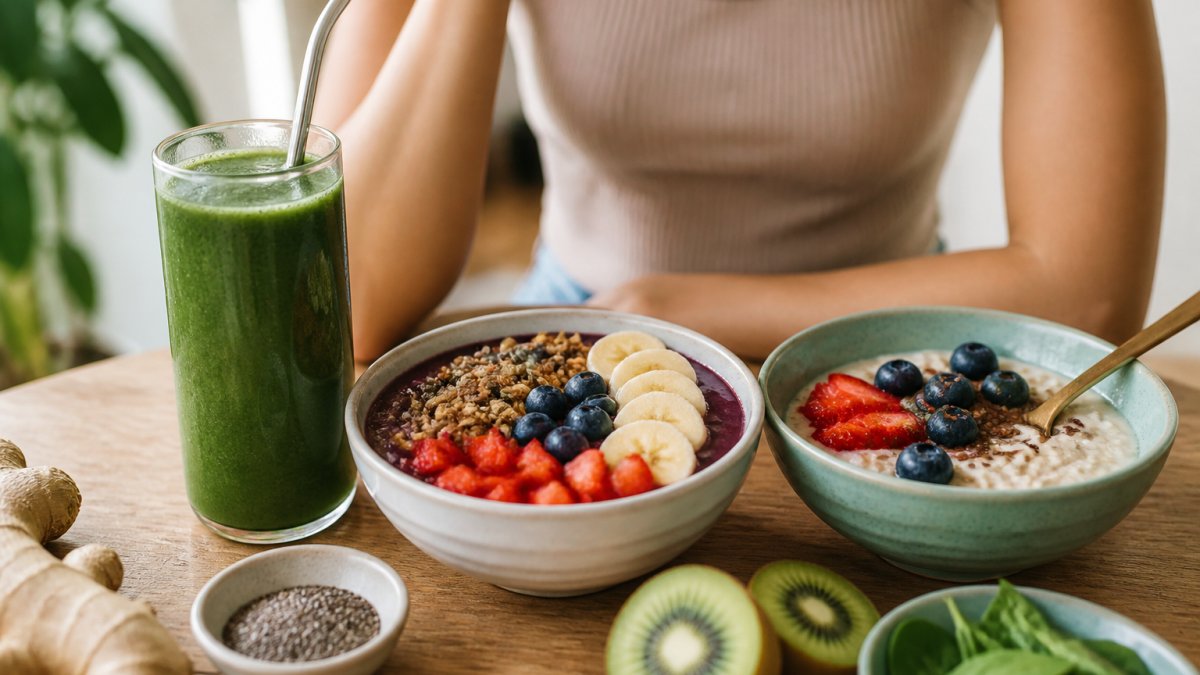
- Overnight oats: Rolled oats, chia seeds, and kefir soaked in a jar overnight. Top with berries.
- Greek yogurt bowl: Plain Greek yogurt with ground flax, walnuts, and sliced banana.
- Smoothie with chia: Blend spinach, frozen berries, banana, and a spoon of chia seeds.
Probiotic Breakfast Foods That Feed Your Gut Flora
Probiotic breakfast foods deliver live bacteria straight to your digestive tract. The most common sources are fermented dairy, fermented vegetables, and brine-based drinks. Each brings different strains, so variety matters.
Top options include:
- Kefir: A fermented milk drink with a high count of live cultures. Lifeway Kefir is a widely available choice.
- Plain Greek yogurt: Fage Total 0% has live active cultures and no added sugar.
- Raw sauerkraut: Wildbrine Organic Raw Sauerkraut adds probiotics to savory breakfasts.
- Fermented pickle juice: Olive My Pickle Probiotic Pickle Juice offers a dairy-free option.
Check the label for the words "live and active cultures." Pasteurized products do not carry live probiotics.
Pairing Prebiotics With Probiotics for Better Results
Pairing prebiotics with probiotics gives live bacteria something to eat once they reach your gut, the synbiotic effect.
Simple pairs that work:
- Kefir plus chia seeds
- Greek yogurt plus ground flax
- Sauerkraut plus whole grain toast
- Pickle juice plus a banana
You do not need fancy supplements. Real food combinations do the job.
Foods to Avoid for Digestive Issues in the Morning
Foods to avoid for digestive issues include highly processed cereals, sugary pastries, and heavy fried foods. These spike blood sugar, feed the wrong bacteria, and often trigger bloating or a mid-morning crash.
Watch out for:
- Sweetened cereals with little fiber
- Flavored yogurts with added sugar
- Fried breakfast meats
- White toast with jam and nothing else
If You Have IBS, SIBO, or a Sensitive Gut
Generic "avoid sugar and fried food" advice is where most breakfast guides stop.
What FODMAPs actually are. FODMAP stands for fermentable oligosaccharides, disaccharides, monosaccharides, and polyols, short-chain carbohydrates that pull water into the intestine and ferment quickly, producing gas.
Common breakfast FODMAPs to watch.
| Food | FODMAP Type | Why It Triggers |
|---|---|---|
| Honey, agave, high-fructose syrup | Excess fructose | Ferments fast, draws water into the gut |
| Cow's milk, soft cheeses, flavored yogurt | Lactose | Undigested in lactose-intolerant guts |
| Wheat bread, wheat cereal, granola with wheat | Fructans | Ferment rapidly, produce gas |
| Apples, pears, mango, watermelon | Excess fructose, polyols | Common smoothie and bowl toppings |
| Cashews, pistachios | Fructans, GOS | Popular in nut butters and granolas |
| Blackberries, cherries, dried fruit | Polyols, excess fructose | Concentrated sugars in small servings |
| Sugar-free gum, mints, some protein powders | Polyols (sorbitol, xylitol) | Slow absorption, ferment in colon |
Lower-FODMAP swaps that still hit the framework.
- Swap cow's milk for lactose-free milk or kefir made from lactose-free milk
- Swap wheat granola for oats, quinoa flakes, or buckwheat
- Swap apples and pears for strawberries, blueberries, or kiwi
- Swap cashew butter for peanut butter or almond butter (limit to 2 tablespoons)
When to get help. If bloating, pain, or bowel changes persist more than a few weeks, or you suspect SIBO, work with a registered dietitian or gastroenterologist.
The Bottom Line on Avoidance
You do not need to eliminate every food on this list, just know which ones your gut reacts to. Remove the obvious offenders (added sugar, fried meats, refined grains) for two weeks and see how you feel. If symptoms persist, look at FODMAPs and get individualized guidance.
How to Balance Protein, Healthy Fats, and Complex Carbs
Balancing protein, healthy fats, and complex carbs at breakfast keeps blood sugar steady and gut bacteria well fed. Most people get plenty of carbs and not enough protein or fat, the difference between a morning that holds and one that collapses.
A simple ratio to aim for:
- Protein: 20 to 30 grams (Greek yogurt, eggs, nut butter)
- Healthy fats: 10 to 15 grams (chia, flax, avocado, nuts)
- Complex carbs: 30 to 45 grams (oats, whole grains, fruit)
Why This Ratio Prevents the 10 A.M. Crash
A carb-only breakfast, toast with jam, a fruit smoothie, a bowl of cereal, digests fast.
Protein and fat slow gastric emptying and flatten the glucose curve. Fiber from complex carbs adds viscosity in the small intestine, further slowing sugar absorption.
A useful way to think about it: carbs are the fuel, protein and fat are the brakes. Without brakes, you burn hot and fast, then stall.
A Side-by-Side Comparison
| Breakfast | Protein | Fat | Fiber | Typical Outcome |
|---|---|---|---|---|
| Cereal + skim milk + banana | ~8 g | ~2 g | ~3 g | Hungry by 10 a.m., energy dip |
| Bagel + cream cheese + juice | ~10 g | ~10 g | ~2 g | Quick spike, crash by mid-morning |
| Greek yogurt + chia + berries + walnuts | ~25 g | ~14 g | ~10 g | Steady energy through lunch |
| Eggs + whole grain toast + avocado + sauerkraut | ~22 g | ~18 g | ~9 g | Sustained satiety, minimal bloating |
Notice the pattern: the meals that hold you are not lower in calories, they are higher in protein, fat, and fiber. That combination also feeds your microbiome, because fiber and polyphenols from plants reach the colon intact.
Satiety Signals: What Your Gut Is Telling Your Brain
When fiber ferments in your colon, bacteria produce short-chain fatty acids like butyrate, acetate, and propionate. These feed gut cells and stimulate satiety hormones including GLP-1 and PYY, which signal fullness to your brain.
Protein adds a second lever: it is the most satiating macronutrient per calorie and triggers cholecystokinin (CCK), which slows stomach emptying. Fat triggers CCK too. Stack all three and overlapping signals say "we are fine, stop looking for a snack."
How to Hit the Ratio Without Measuring
You do not need a food scale. Use your hand and your bowl:
- Protein: one palm-sized portion (a cup of Greek yogurt, two eggs, or two tablespoons of nut butter)
- Fat: one thumb-sized portion (a tablespoon of chia or flax, a quarter avocado, a small handful of nuts)
- Complex carbs: one cupped-hand portion (half a cup of dry oats, one slice of whole grain toast, or one cup of berries)
Build the plate in that order, protein first, then fat, then carbs, and you will land in the target range without counting.
Adjusting for Your Body and Goals
- If you train in the morning: push carbs toward the higher end (45 g) and eat 60 to 90 minutes before training.
- If you are managing blood sugar: keep carbs on the lower end and pair every carb with protein and fat.
- If you are underweight or recovering: add a second protein source and do not fear healthy fats.
- If you have IBS or a sensitive gut: keep portions moderate and introduce new fiber sources one at a time so you can identify triggers.
Timing Matters: When to Eat Breakfast for Gut Motility
Eating breakfast within one to two hours of waking supports gut motility and your circadian rhythm. Your digestive system runs on a clock, and consistent meal times sync your gut bacteria to that schedule.
Waiting too long can slow motility and lead to constipation. Eating too early, before you feel hungry, can cause bloating. The sweet spot is usually one to two hours after you wake up.
Conclusion: Building a Gut Health Breakfast That Works for You
The best gut health breakfast is the one you will actually eat, made from fiber, fermented foods, and protein that suit your body.
When you are short on time, Roxberry Juice Co. makes it easy to stay on track.
Download our app to find your nearest Roxberry Juice Co. and build a breakfast routine your gut will thank you for.
Frequently Asked Questions
What should I eat first in the morning for gut health?
Start with water to rehydrate after sleep, then eat a breakfast that combines fiber, probiotics, and protein. A bowl of plain Greek yogurt with chia seeds and berries covers all three. If you prefer something warm, oatmeal with ground flax and a spoonful of sauerkraut on the side works too. The goal is to feed beneficial bacteria while avoiding a blood sugar spike that leaves you crashing by mid-morning.
What are the best high fiber breakfast ideas for digestion?
Overnight oats with chia seeds and raspberries deliver both soluble and insoluble fiber. A smoothie bowl blended with spinach, banana, and ground flax offers similar benefits in a colder format. Whole grain toast with avocado adds fiber plus healthy fats. Aim for 8 to 10 grams of fiber at breakfast to support gut motility and keep you full through the morning.
Can a high-protein breakfast support gut health?
Yes, when the protein source also brings probiotics or fiber. Plain Greek yogurt and kefir provide live active cultures alongside protein. Eggs paired with sautéed vegetables or fermented sauerkraut add protein without the sugar load of many grab-and-go options. Protein slows digestion and helps flatten the blood sugar curve, which matters for sustained satiety and steady energy.
What breakfast foods should I avoid for better gut health?
Limit foods high in added sugar, refined flour, and artificial sweeteners, which can disrupt gut flora balance. Sugary cereals, pastries, and flavored coffee drinks spike blood sugar and feed less beneficial bacteria. If you have IBS or SIBO, you may also need to watch high-FODMAP items like certain fruits and sweeteners. Track how you feel after eating and adjust accordingly.