 Listicle
Focus-Friendly Workspace Ideas for Small Rooms
Last Updated: November 20, 2026
Quick Summary
The best focus-friendly workspace ideas for small rooms start with measuring the wall, depth, and door swing before buying a desk, then choosing a wall-mounted or shallow desk 18 to 20 inches deep to free floor space. Fix window glare, add an adjustable lamp, and push storage up the wall so the desktop stays clear.
- Leave at least 30 inches of clearance behind the chair so you can push back without hitting a bed or wall.
- Place the desk so the window sits to your side, never directly behind or in front of the screen.
- A wall-mounted or floating desk is the single best space-saving move for a narrow room.
- Use a desk depth of 24 inches if you work with a separate monitor and keyboard.
- Keep a walking path of 24 to 36 inches for a main route through the room.
Table of Contents
- Why Small Rooms Can Be the Best Focus Spaces
- Very Small Home Office Ideas That Protect Your Focus
- Small Bedroom Workspace Ideas for Better Sleep and Deep Work
- Low-Budget Small Office Interior Design That Still Looks Intentional
- Small Home Office Storage Ideas for a Clutter-Free Desk
- Ergonomics and Acoustics for Compact Workstations
- Plan Your Focus-Friendly Workspace This Weekend
- Frequently Asked Questions
Why Small Rooms Can Be the Best Focus Spaces
A small room removes the biggest enemy of deep work: distance. Fewer square feet mean fewer places for laundry piles, unopened mail, and stray devices to pull your attention sideways. A tight, intentional room works on the principle that fewer distractions lead to better results.
The trick is treating a small room as a design advantage, not a compromise. When everything you need sits within arm's reach, you stop getting up every ten minutes to hunt for a charger or a notebook.
Below, we'll show you focus-friendly workspace ideas for small rooms and exactly how to turn a cramped corner into a space that helps you concentrate. If you want the full step-by-step process, our guide on how to create a focus-friendly workspace walks through the whole build from measurement to final setup.
Very Small Home Office Ideas That Protect Your Focus
Very small home office ideas work best when they start with the desk, not the decor. The right desk in the right spot does more for concentration than any wall hanging. Get the desk wrong and no amount of styling will fix the room.
Measure First, Then Choose a Desk
Grab a tape measure before you buy anything. Note the wall length, the depth from wall to doorway, and how far the door swings. A desk that blocks the door swing or eats the walking path will make the room feel tighter than it is.
Watch out: people buy a desk that fits the wall but forget the chair. Leave at least 30 inches of clearance behind the seat so you can push back without hitting a bed or a wall.
Wall-Mounted and Floating Desks for Tight Floor Plans
A wall-mounted desk is the single best space-saving move for a narrow room. With no legs, the floor stays visually open and you can slide a stool or small cabinet underneath. Floating shelves above it give you vertical storage without a bookcase footprint.
For a built-in desk, choose a depth of 18 to 20 inches. That fits a laptop, a notebook, and a mug without turning the room into a corridor.
Small Bedroom Workspace Ideas for Better Sleep and Deep Work
Small bedroom workspace ideas have one extra job: they must protect sleep and protect focus at the same time. A desk in the bedroom is fine, as long as your brain can tell the difference between work hours and rest hours, and as long as the desk is positioned so the rest of the room stops interrupting you.
Position the Desk Against Distraction, Not Just Against the Wall
Most people put the desk wherever it fits. A better method is to place it where your field of view is boring.
Keep the desk on the wall farthest from the bed and, where possible, facing away from it.
Watch out: a desk placed under a window looks great in photos but puts bright light directly behind your monitor during the day, which forces your eyes to constantly readjust.
Build a Shut-Down Ritual That Actually Ends the Workday
A desk in the bedroom only works if work visibly ends. At the end of the day, close the laptop, cover it with a cloth or a dedicated cover, and clear the surface completely, no mug, no notebook, no charger left out.
A common pattern is to treat the desk as a nightstand after hours. That backfires: your brain learns that the work surface is also the wind-down surface, and neither job gets done well.
If you want practical habits to reinforce that boundary, our article on digital minimalism for remote workers covers the phone and notification side of the same problem. And if your desk doubles as a nightstand, an evening routine for better sleep helps you wind down without scrolling in bed.
Use Sound and Sightlines to Fake a Separate Room
You cannot add walls, but you can add cues. With the boundary and rug in place, arranging the desk, chair, and storage to keep the work zone clear can make the room feel more intentional, a principle reflected in ItaliaHome’s approach to small home office layouts.
For noise, soft surfaces are the cheapest fix: a rug, a fabric chair, curtains, and a shelf of actual books. The goal is not silence, it is removing the sharp, attention-grabbing sounds that pull you out of deep work.
Low-Budget Small Office Interior Design That Still Looks Intentional
Low-budget focus-friendly workspace ideas for small rooms come down to three things: light, layout, and restraint. You do not need new furniture. You need to fix glare, plan the footprint before you buy, and stop buying storage you do not have room for.
Lighting and Screen-Glare Control on a Budget
Glare is the most common reason a small workspace feels tiring, and it is almost always a placement problem, not a lamp problem.
For task lighting, one adjustable desk lamp beats a brighter overhead fixture. Place the lamp on the opposite side from your writing hand so your own shadow does not fall across the desk.
Watch out: overhead light alone flattens a small room and tires your eyes faster, and a single bright bulb in a dark room creates harsh contrast that makes screens harder to read.
Plan the Footprint Before You Spend
Before buying anything, sketch the room on paper with real measurements. Note wall length, depth from wall to doorway, and how far the door swings.
Use these working numbers as a starting point:
- Desk depth: 18 to 20 inches for a laptop setup; 24 inches if you use a separate monitor and keyboard.
- Chair clearance: at least 30 inches behind the seat so you can push back without hitting a bed or wall.
- Walking path: 24 to 36 inches for a main route through the room.
- Monitor distance: roughly an arm's length (about 20 to 30 inches) from your eyes.
A wall-mounted or floating desk is the single best space-saving move for a narrow room. With no legs, the floor stays visually open and you can slide a stool or small cabinet underneath. Floating shelves above it give you vertical storage without a bookcase footprint.
Spend on Light and Storage, Skip the Rest
On a tight budget, the highest-return purchases are an adjustable lamp, a wall organizer or pegboard, and cable clips. Those three fix glare, clear the desktop, and remove daily friction. Skip decorative shelving, matching furniture sets, and anything that adds footprint without adding function. Restraint is what makes a small room look intentional rather than crowded.
Small Home Office Storage Ideas for a Clutter-Free Desk
Small home office storage ideas should push clutter up the wall, not across the desk. The goal is a surface that holds only what you are using right now.
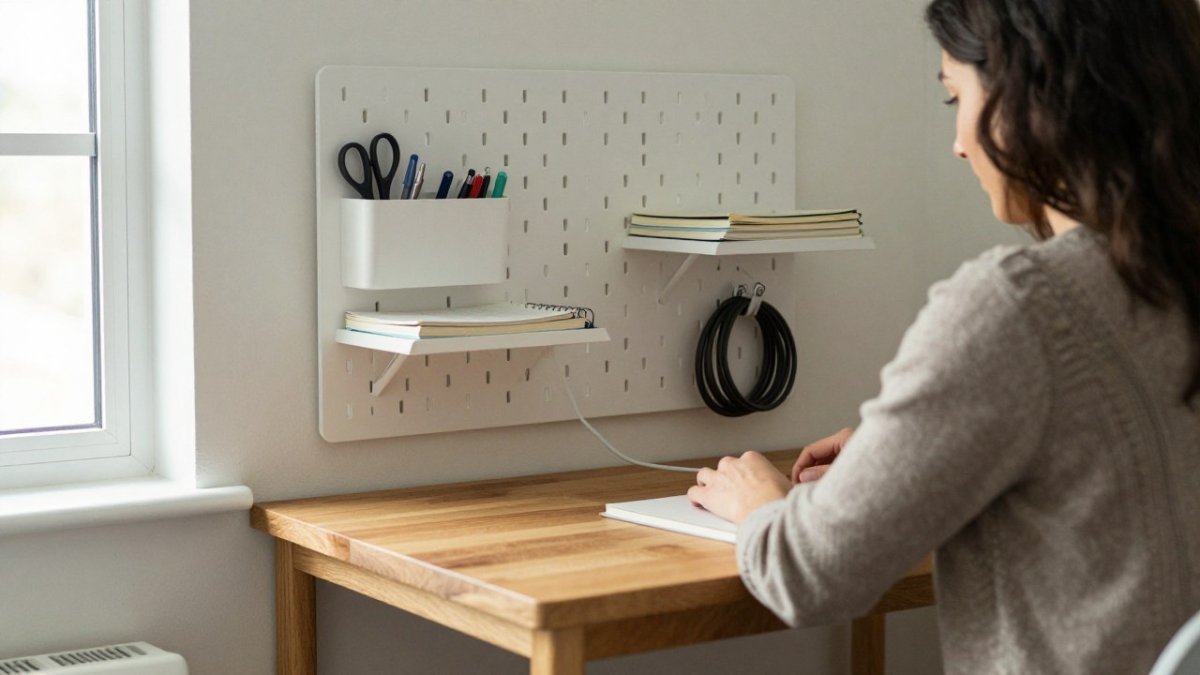
Start with a pegboard or a wall-mounted organizer above the desk. Hanging tools and supplies frees the entire work surface. Floating shelves handle books and bins, and a single drawer unit on casters stores the rest out of sight.
Cable Management and Tech Setup
Route cables along the back edge of the desk with clips, then drop them behind the desk in one bundle. Label each charger so you stop unplugging the wrong one. A tidy tech setup removes a surprising amount of low-grade friction from your day. For more on cutting digital clutter, see our guide on reducing digital overwhelm.
Ergonomics and Acoustics for Compact Workstations
Ergonomics for a compact workstation start with three numbers: screen height, elbow angle, and foot support. Set the top of the monitor at eye level, keep elbows near 90 degrees, and use a footrest if your chair sits high at a shallow desk. Small desks often force the keyboard too close, so push the monitor back and keep the keyboard at the front edge.
Noise is the other half. A small room echoes, and hard floors make it worse. A rug, a fabric chair, and a bookshelf with actual books absorb sound cheaply. If you take a lot of calls, a folding acoustic panel behind your seat softens the bounce. Simple habits that naturally increase mental clarity pair well with a quieter, better-arranged corner.
Plan Your Focus-Friendly Workspace This Weekend
Here is the whole plan on one page. Measure on Saturday morning, buy only what the measurements demand, and set up on Sunday.
| Step | Task | Time | Why It Matters |
|---|---|---|---|
| 1 | Measure wall, depth, and door swing | 15 min | Prevents a desk that blocks the room |
| 2 | Choose a wall-mounted or shallow desk | 30 min | Frees floor space in narrow rooms |
| 3 | Fix window glare and add a desk lamp | 20 min | Reduces eye strain and screen reflection |
| 4 | Mount pegboard and floating shelves | 45 min | Clears the desktop completely |
| 5 | Bundle and clip cables | 15 min | Removes daily friction |
| 6 | Add a rug or panel for sound | 20 min | Softens echo in hard-surfaced rooms |
Start with the desk and the light. Those two changes carry most of the benefit, and everything else is refinement.
A focused workspace only works if your body has the energy to use it. That is where we come in. Roxberry Juice Co. presses real fruits and vegetables into fresh juices and blends smoothies to order, with açaí bowls topped with our signature Roxberry Granola.
Frequently Asked Questions
Where should you put a desk in a small room?
Put the desk where your back faces a wall or corner, not a doorway or a busy hallway, so movement does not pull your eyes away every few minutes. Measure the wall first, then pick a desk depth that leaves at least 30 inches of clear floor behind the chair for pulling in and out. If the room has one window, place the desk perpendicular to it so daylight lands on the side of your screen rather than straight on it, which cuts glare without blocking the view.
How can I make a very small home office feel less distracting?
Keep only what you use daily within arm's reach, and move everything else into closed storage so your eyes have fewer things to land on. A wall-mounted organizer or pegboard holds pens, chargers, and notebooks without eating desk space. Add a soft surface, such as a rug or an upholstered chair, to reduce echo in a room with hard floors. If noise is the main problem, a pair of closed-back headphones or a felt panel behind your monitor does more for focus than rearranging furniture.
What furniture works best in a very small home office?
A narrow writing desk, roughly 36 to 42 inches wide and 18 to 20 inches deep, fits most small rooms without crowding the chair zone. Wall-mounted and floating desks free up floor space and make the room feel larger. Choose multi-purpose pieces where you can: a desk with a built-in shelf, a storage ottoman that doubles as a seat, or a folding table that tucks away when work ends. Skip anything deeper than 24 inches unless the room is genuinely large enough to absorb it.
How do I keep a small bedroom workspace from hurting my sleep?
Separate work from rest with a visual cue you can switch off, such as a desk lamp that stays off after hours or a folding screen you close at the end of the day. Put the desk on the wall opposite the bed if the layout allows, so you are not looking at work from under the covers. Store your laptop in a drawer or closed cabinet overnight. These small bedroom workspace ideas matter because a desk you can see from bed keeps your brain in work mode long after you clock out.
Time needed for each workspace setup step