 listicle
How to Add Prebiotic Ingredients to Morning Smoothies
Last Updated: October 29, 2026
Quick Summary
Good prebiotic ingredients for a morning smoothie include green banana, rolled oats, chia seeds, ground flaxseed, apple with skin, spinach and green banana flour. These are nondigestible fibers that feed the beneficial bacteria already in your gut. Start with one source at a small serving and increase slowly.
- Green banana is the best overall base, with about 3-4 g of fiber per medium banana.
- Chia seeds deliver the most fiber per spoonful, at about 4-5 g per tablespoon.
- Start with one fiber source at a small serving to limit bloating and gas.
- Drink water with and after the smoothie to help fiber move through your gut.
- See a doctor about persistent bloating or bowel changes before changing your diet.
Table of Contents
- Why Prebiotics Belong in Your Morning Smoothie
- Signs of Poor Gut Health and How Prebiotic Fiber Helps
- The Best Prebiotic Ingredients to Blend, Ranked
- 1. Green (Underripe) Banana, Best Overall Base
- 2. Rolled Oats, Best Filling Fiber
- 3. Chia Seeds, Best Texture and Fiber Density
- 4. Ground Flaxseed, Best for Omega-3s Plus Fiber
- 5. Apple (with Skin), Best Familiar Fruit Fiber
- 6. Spinach, Best Low-Calorie Greens Addition
- 7. Cooked-and-Cooled Potato or Green Banana Flour, Best Concentrated Resistant Starch
- Quick Ranking at a Glance
- Prebiotic vs Probiotic for Digestion: What Goes in the Blender
- A Simple Gut Health Smoothie Recipe to Start With
- Serving Sizes, Substitutions, and Easing Into More Fiber
- Bring Your Gut-Friendly Smoothie Home with Roxberry
- Frequently Asked Questions
Why Prebiotics Belong in Your Morning Smoothie
Prebiotic ingredients to add to morning smoothies are a simple way to feed the bacteria already living in your gut. A prebiotic is a nondigestible food ingredient that beneficially affects the host, according to a 2019 review of prebiotic definitions and mechanisms. Your body cannot break these fibers down, so they pass through to the microorganisms that use them.
The morning is an easy place to start. A blender takes about a minute to run, and it puts fiber-rich fruit, seeds, and greens into one glass you can drink on the way out the door.
The category is getting attention too.
The sections below show which additions earn their place in the blender and how to use them.
Signs of Poor Gut Health and How Prebiotic Fiber Helps
Digestive discomfort is common. Use this checklist of gut health warning signs to compare against your own symptoms. If you notice persistent bloating, irregular bowel habits, or low energy after meals, it is worth talking with a doctor before changing your diet. A smoothie is not a diagnosis.
Fiber matters here because it is the raw material your gut bacteria work with. Mayo Clinic's overview of probiotics and prebiotics explains that prebiotics are food parts the body does not digest, which may trigger the growth of beneficial microorganisms.
Think of fiber as food for those microorganisms. Bananas, oats, chia, and flaxseed all contain fiber.
The Best Prebiotic Ingredients to Blend, Ranked
Most gut-health smoothie roundups mix prebiotic and probiotic foods into one recipe list. This section does something different: it ranks prebiotic add-ins only, by how well they blend, how much fiber they contribute per realistic serving, and how little they disrupt taste.
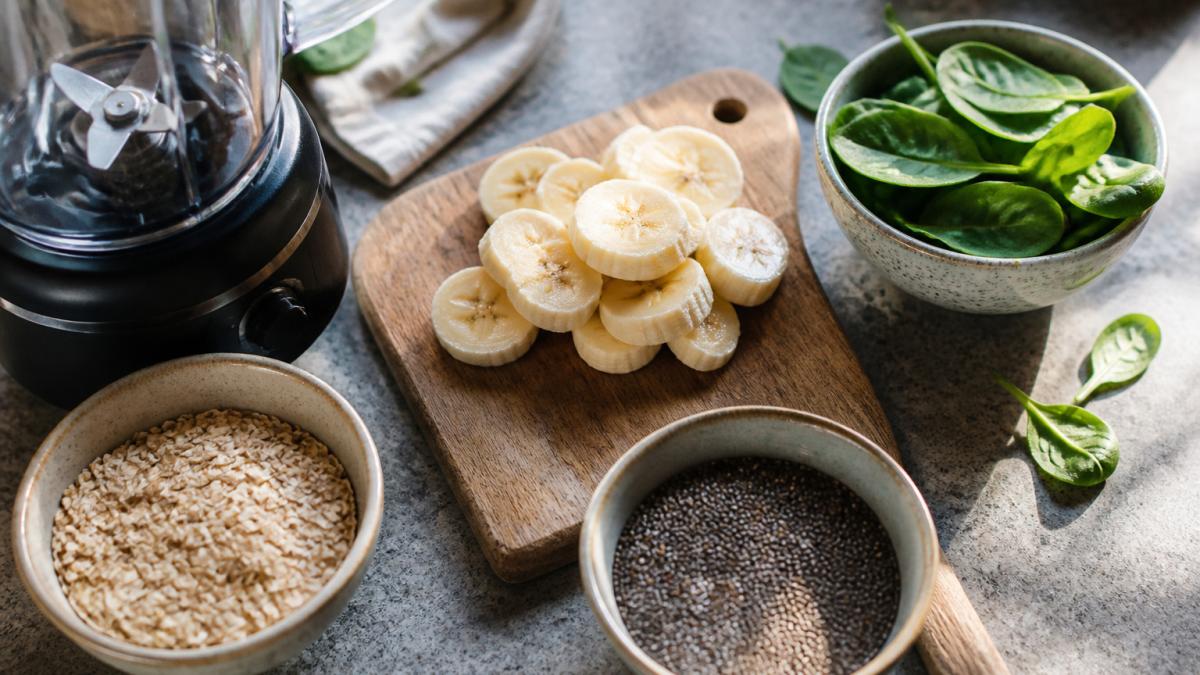
1. Green (Underripe) Banana, Best Overall Base
- Serving: 1 medium banana, ideally yellow-green
- Approximate fiber: 3-4 g
- Why it ranks first: creamy body, mild flavor, pairs with almost everything, and the resistant starch is the headline prebiotic
- Trade-off: very green bananas are harder to blend and less sweet; balance with a ripe fruit or a date
2. Rolled Oats, Best Filling Fiber
- Serving: 1/4 to 1/2 cup rolled oats
- Approximate fiber: 2-4 g
- Why it ranks high: cheap, shelf-stable, and the beta-glucan is one of the better-studied prebiotic fibers
- Trade-off: too many oats turn a smoothie into a paste; start at 1/4 cup
3. Chia Seeds, Best Texture and Fiber Density
- Serving: 1 tablespoon
- Approximate fiber: 4-5 g
- Why it ranks high: highest fiber per tablespoon of the seeds here, and the gel improves mouthfeel
- Trade-off: dry chia can feel gritty and can swell uncomfortably if eaten with too little liquid, drink water alongside
4. Ground Flaxseed, Best for Omega-3s Plus Fiber
- Serving: 1 tablespoon, ground
- Approximate fiber: 2-3 g
- Why it ranks here: good fiber plus a nutrient bonus, and it disappears into fruit-forward blends
- Trade-off: whole seeds are far less useful; store ground flaxseed cold because it goes rancid
5. Apple (with Skin), Best Familiar Fruit Fiber
- Serving: 1/2 medium apple, skin on
- Approximate fiber: 2-3 g
- Why it ranks here: widely available, kid-friendly, and pectin is a well-known prebiotic fiber
- Trade-off: apple is one of the higher-FODMAP fruits; see the substitutions section if you are sensitive
6. Spinach, Best Low-Calorie Greens Addition
- Serving: 1 large handful (about 1 cup packed)
- Approximate fiber: 1 g or less
- Why it ranks here: near-invisible in a fruit blend and a low-effort way to add greens
- Trade-off: raw spinach is high in oxalates; if you are prone to kidney stones, rotate greens and talk to a clinician
7. Cooked-and-Cooled Potato or Green Banana Flour, Best Concentrated Resistant Starch
Green banana flour is the easiest way to add it to a smoothie because it blends into a powder.
- Serving: 1 to 2 tablespoons green banana flour, or about 1/2 cup cooled cooked potato
- Approximate fiber: varies widely by product; check the label
- Why it ranks here: the most direct resistant-starch add-in, and a powder disappears completely
- Trade-off: start very small, concentrated resistant starch is a common trigger for gas in people who add it too fast
Quick Ranking at a Glance
| Rank | Ingredient | Serving | Approx. fiber |
|---|---|---|---|
| 1 | Green banana | 1 medium | 3-4 g |
| 2 | Rolled oats | 1/4-1/2 cup | 2-4 g |
| 3 | Chia seeds | 1 tbsp | 4-5 g |
| 4 | Ground flaxseed | 1 tbsp | 2-3 g |
| 5 | Apple, skin on | 1/2 medium | 2-3 g |
| 6 | Spinach | 1 handful | ~1 g |
| 7 | Green banana flour | 1-2 tbsp | label varies |
Best for: anyone who wants a comparable, portion-aware list rather than another recipe. If you only add one thing, start with green banana or oats; if you want the most fiber per spoonful, chia wins.
Prebiotic vs Probiotic for Digestion: What Goes in the Blender
Prebiotics and probiotics are often confused. Prebiotics are the fiber that feeds bacteria. For a fuller explanation of how the two differ and work together, read Probiotics vs Prebiotics for Digestion Benefits. Probiotics are live microorganisms. Many smoothie recipes combine both, pairing fiber-rich fruit with kefir or Greek yogurt.
If you are unsure which to focus on, start with prebiotics. They are the ingredients you can control most easily in a blender, and they do not require refrigerated live cultures to stay effective.
A Simple Gut Health Smoothie Recipe to Start With
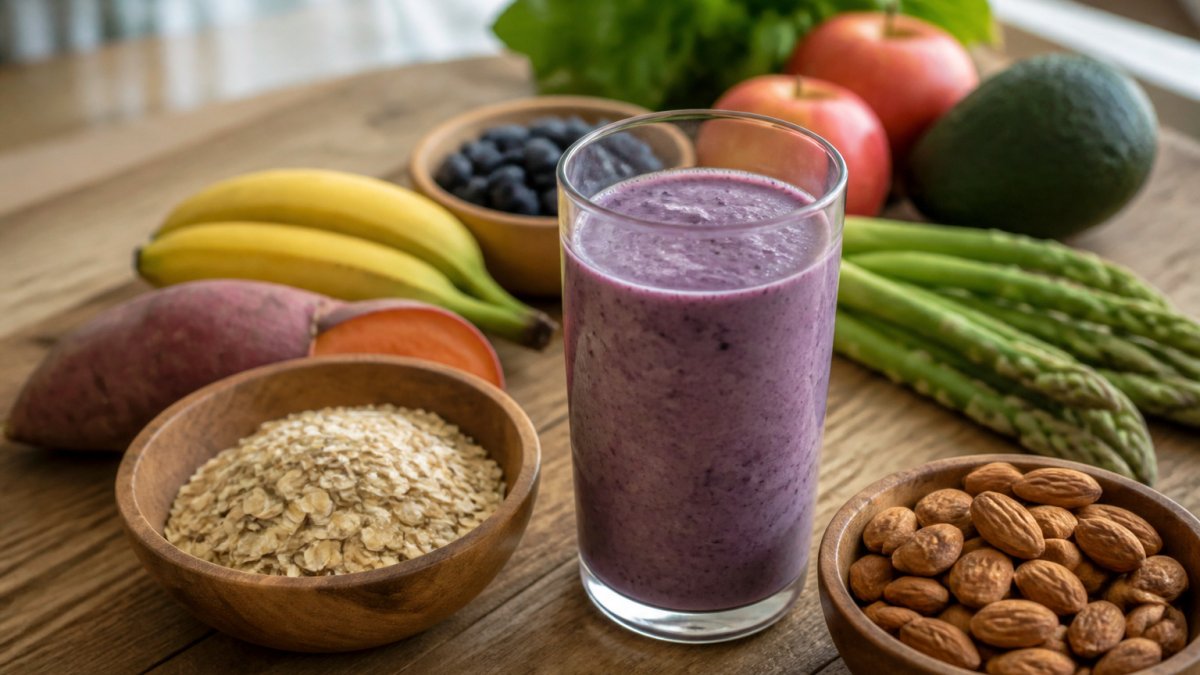
Here is a basic morning blend we would start with:
- 1 slightly green banana
- 1 handful of spinach
- 1 tablespoon ground flaxseed
- 1 tablespoon chia seeds
- 1/2 cup rolled oats
- 1 cup unsweetened plant-based milk or plain Greek yogurt
- Ice to taste
Blend until smooth. Add more liquid if it is too thick. If you want a probiotic boost, swap the milk for plain kefir.
Serving Sizes, Substitutions, and Easing Into More Fiber
This is the part most smoothie articles skip, and it is the part that decides whether a new fiber habit sticks. Prebiotic fibers feed gut bacteria, and when you add a lot at once, those bacteria ferment the fiber and produce gas. That is normal, but it is also why a sudden jump in fiber causes bloating and cramping. The fix is pacing, not avoidance. Gradual integration allows your digestive system to adapt comfortably, much like the steady consistency required to maintain a successful daily supplement routine.
How to Increase Fiber Without the Bloat
A common pattern that practitioners recommend:
- Week 1-2: add one prebiotic source at a modest serving, 1 tablespoon chia or ground flaxseed, or 1/4 cup oats.
- Week 3-4: add a second source, or increase the first serving slightly.
- Ongoing: increase every week or two until you reach a comfortable level, and hold there before adding more.
Drink water with and after the smoothie. If gas or bloating becomes uncomfortable, drop back to the previous level for a week and try again, do not push through it. If fiber still causes gas, you can compare digestive enzyme options for bloating and gas.
Substitutions for Dietary Needs
- Dairy-free: swap Greek yogurt or kefir for unsweetened oat, almond, soy, or coconut milk.
- Low-FODMAP: apple, very green banana, and some concentrated resistant-starch powders are higher-FODMAP. Lower-FODMAP swaps include unripe banana in small amounts, oats in modest servings, chia, and spinach. Work with a dietitian if you are following the diet strictly.
- Gluten-free: oats are often cross-contaminated in processing, choose oats labeled gluten-free. Chia, flaxseed, banana, apple, and spinach are naturally gluten-free.
- Nut-free: use seed-based milks (oat, sunflower, or coconut) and skip nut butters; chia and flaxseed are seed-based and generally fine unless you have a specific seed allergy.
- Texture-sensitive: grind chia and flaxseed, pulse oats into flour, and use ripe banana rather than green if the starchiness bothers you, you trade some resistant starch for a smoother drink.
Preparation Tips That Keep It Drinkable
- Add seeds last and blend an extra 20-30 seconds; chia and flaxseed thicken fast.
- If a blend gets too thick, add liquid a splash at a time rather than more fruit.
- Frozen banana and frozen spinach both blend smoother than fresh and chill the drink without ice dilution.
- Soak oats in the liquid for a few minutes before blending if you want a silkier texture.
Bring Your Gut-Friendly Smoothie Home with Roxberry
Roxberry Juice Co. blends smoothies to order using real fruits and vegetables, so you can get a fresh start without the prep. Our locally owned stores focus on transparent ingredients and nourishing options for busy mornings.
If you want the convenience of a ready-made blend, order a fresh smoothie from our menu. Want to go deeper on digestion? Read about the benefits of fermented foods to add another gut-supporting ingredient to your routine.
Frequently Asked Questions
What are the best prebiotic foods to add to smoothies?
Bananas (especially slightly green ones), oats, chia seeds, flaxseed, apples, and leafy greens such as spinach are among the most commonly named prebiotic smoothie ingredients. The Healthline and Blendi prebiotic food guides both list these foods, and Verywell Health names chia, flax, oats, berries, and slightly green bananas as fiber-rich add-ins. Start with one or two of these in your blend and build from there, since variety across fruits, seeds, and greens gives your gut a wider range of fibers to work with.
How do prebiotics improve digestive health?
Prebiotics are nondigestible food components that your body does not break down. Instead, they reach the colon, where beneficial microorganisms can use them. The National Center for Complementary and Integrative Health describes prebiotics as nondigestible food components that selectively stimulate desirable microorganisms, and Mayo Clinic notes they may trigger the growth of beneficial microorganisms. Research on specific outcomes varies by ingredient and person, so these effects should not be treated as guaranteed.
Can you mix prebiotics and probiotics in a smoothie?
Yes. A common approach pairs prebiotic fiber foods, such as bananas and raspberries, with probiotic-rich ingredients like kefir or Greek yogurt, as EatingWell describes in its gut-healthy smoothie roundup. Probiotics supply live microorganisms, while prebiotics feed the microorganisms already in your gut.
Are there any side effects of adding prebiotics to smoothies?
Adding a lot of fiber quickly can cause gas, bloating, or cramping, particularly if your diet is currently low in fiber. Increase prebiotic ingredients gradually over a few weeks and drink plenty of water. People with irritable bowel syndrome or other digestive conditions should check with a healthcare provider before making large changes.